In Vite Veritas — when the vine becomes leatherwork
How a conversation with a vineyard owner at the Salon du Made in France 2024 gave birth to two pieces in French grape marc "skin".
Contents
"Vegan leather": what the term really hides
An illegal term — and a misleading one
"The use of the word 'leather', as a principal term, root word or adjective, in any language, is prohibited in the designation of any material other than that obtained from animal skin through tanning or impregnation preserving the natural structure of the skin fibres."
Let's start here, because it matters: "vegan leather" is illegal under French law. Legally, the word "leather" is reserved for tanned animal hides — full stop. That rules out "faux leather", "fake leather" and other trendy alternatives. On top of that, the term plays on a real confusion with "vegetable-tanned leather" — a quality benchmark known to enthusiasts, which refers to a traditional tanning process. Completely unrelated. But it borrows the prestige.
That's not an accusation — it's the reality of the market. For me, naming things correctly — being transparent, honest, and on the right side of the law — is part of the work. If it's grape marc "skin", I say grape marc "skin". If it's Kraft-Tex, I say Kraft-Tex. If it's faux leather, I say so — and I no longer use it.
The reality of common alternative materials
A non-exhaustive overview of what currently exists as leather alternatives:
| Material | Origin | Synthetic backing? |
|---|---|---|
| Faux leather (PU/PVC) | Generally Asia | Yes |
| Cork | Portugal, Spain | Often yes |
| Piñatex (in administration since 2024) | Philippines / Spain | Yes |
| Vegea | Italy | Yes |
| Nisiar | France | No |
Others exist — mycelium-based ones like Veshin, for instance — but often reserved for industrial volumes. This table is illustrative, not exhaustive.
Why I searched for an alternative
My non-negotiable criteria
I make pieces that last. Not seasonal accessories. When I source a material, I'm not looking for what's trending — I'm looking for what will still hold up in ten years, what won't peel, what won't crack after six months of daily use.
Leather meets those criteria. But clients regularly ask me for alternatives — not out of dogmatism, more because they want to consume differently. I've occasionally used faux leather when explicitly asked — but it never satisfied me. I wasn't about to offer them a material claiming to be "plant-based" in big letters while hiding a polyester backing and a coating that's mostly plastic.
And there's a question I don't want to dodge: did you know that using an existing "skin" — an inevitable by-product of the food industry — could be less energy-intensive than destroying it? That's what a 2021 study commissioned by the Leather Working Group suggests, with all the caveats that implies about its conclusions. It's not a blank cheque for the leather industry — it has considerable room to improve, probably by producing less volume and encouraging more considered consumption. But it does invite us to think more carefully than "leather = bad, plant-based = good".
My criteria list:
- Durability — it holds, cuts cleanly, seams don't give out
- Traceable origin — I need to be able to tell you where it comes from and how it's made
- No synthetic backing — a polyester backing bothers me in principle
- No artificial dye — if the material is already beautiful, why mask it?
- Aesthetic coherence — with my other materials, with the universe I'm building
Compromises come later, on details. Not on the baseline criteria.
The Salon du Made in France 2024
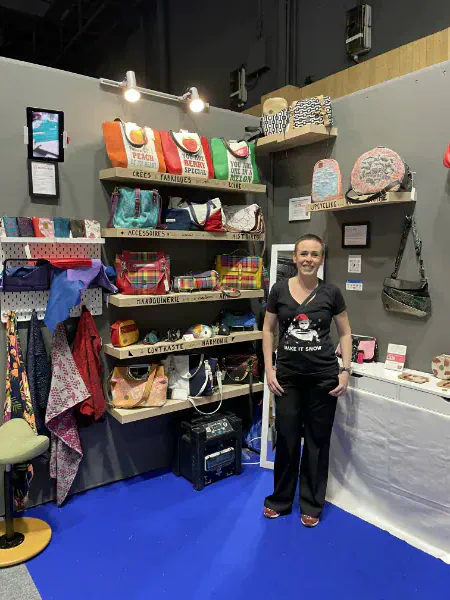
At the Salon du Made in France 2024, I met a vineyard owner. He wanted to develop a range of derivative products around his estate — he already had cosmetics, and my bags interested him. I explained that I don't do series production, but that I could think about a collection I would design myself, centred on materials linked to wine culture in France. We exchanged cards. We were supposed to meet again in early 2025.
Thinking it over on my own, I remembered having seen an advert a few years back for a grape-based material — Vegea — and dismissing it as "another one". I wanted to see where things stood. In looking, I found Nisiar. French. No synthetic backing. I contacted them, they sent me samples.
The project followed the bumpy path that projects sometimes take. It was the following summer that I decided not to wait any longer: I launched the prototypes, made the pieces. The collection exists. The conversation with him too — but that's for later.
What exactly is Nisiar?
The "skin"
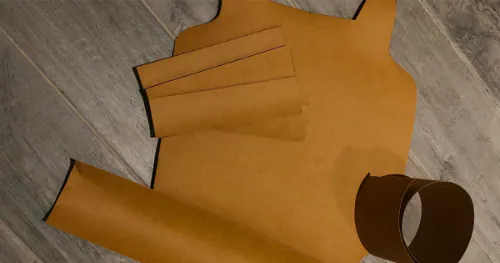
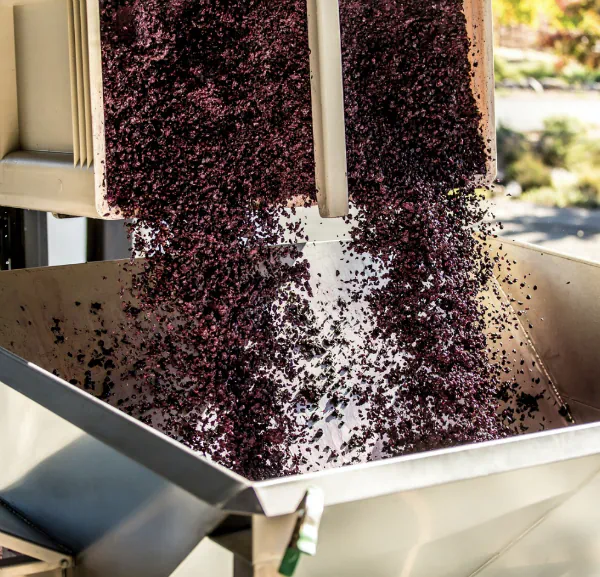
Nisiar is a French brand that produces a bio-based "skin" from grape marc — what remains after pressing during the harvest. This isn't marginal valorisation: marc represents a significant share of French wine production, and Nisiar makes something concrete with it.
73% plant-based materials, no synthetic backing, no artificial dye — the appearance comes from the marc itself. Two references used in this collection: the N-07 at 0.8 mm and the Millésime 2022 at 0.5 mm. Made in France.
I'm not going to give you a carbon footprint figure — I don't have one, and I'm wary of those who brandish one without explaining their calculation method. What I can tell you is what I verified myself: no synthetic backing that peels off, no dye masking the "skin", an origin I can trace.
The appearance is the vintage
This is where it gets genuinely interesting, and where I understood this material was made for me.
The appearance of Nisiar "skin" is not standardised. It depends on the marc — so on the harvest, the grape variety, the territory. This is not a production defect: it's a traceability feature. Each batch has an appearance that belongs to it, linked to a specific year and terroir.
The light dappled brown of the Pyramide Pouch comes from the 2023 harvest, Rhône Valley, Famille Perrin.
The deep ebony brown of the Mini En Ville Wallet comes from the 2022 harvest — Nisiar refines its formula year on year, so each batch has its own character.
Two "skins". Two years. Two characters. Like wine.
What I know so far
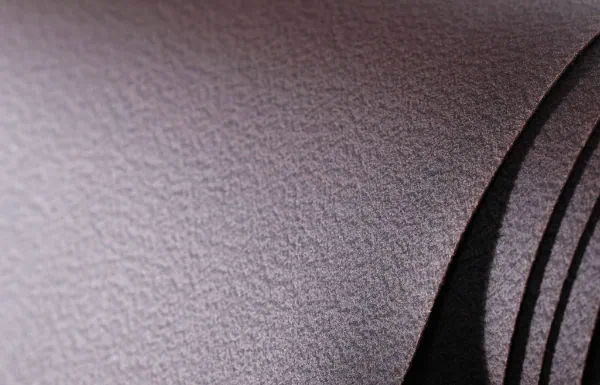
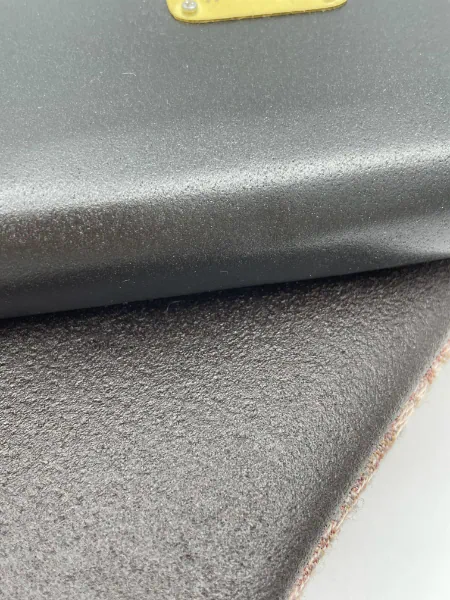
The hand is different from leather — lighter, slightly satin on the N-07, finer and almost sparkling on the Millésime 2022. The smell is different too: the N-07 smells of roasted cocoa.
I can't talk to you about patina over ten years — I've only been using it for a few months. What I can tell you is that right now, it inspires confidence.
What I made with it — the In Vite Veritas collection
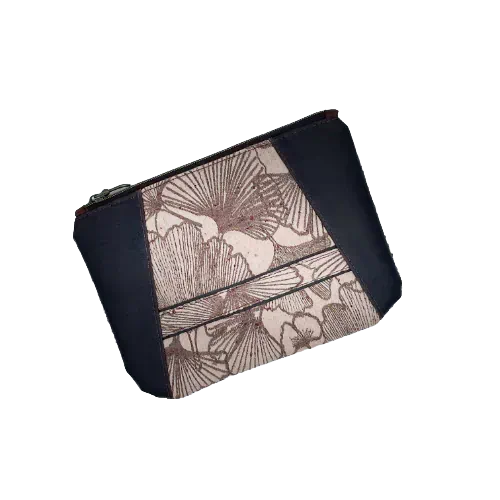
Pyramide Pouch
The Pyramide pattern has always surprised me with its capacity despite its slimness. Compact but practical — that's the exact definition of what I look for when making a pouch.
For this version, I combined the N-07 "skin" (light dappled brown, 2023 harvest) with a Levate baby carrier wrap with a Ginkgo Biloba pattern — noble fibre, babywearing history, colours that converse with the brown-pink tones of the "skin". The fineness of the material contributes to the shape of the pouch, the slightly satin quality to its character. Nothing is there by accident.
→ See the Pyramide Pouch product page
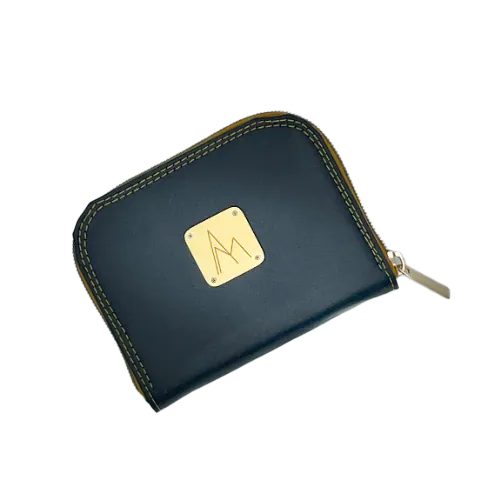
Mini En Ville Wallet
The Mini En Ville wallet is a format I've worked with across several collections: zip all around, card and note compartments, compact enough to slip into a pocket or a bag. I don't sacrifice practicality for aesthetics.
For the Millésime 2022, the "skin" is darker, finer grain, with a subtle sparkle under light. The interior adds a touch of hidden fantasy: an iridescent red and black satin fabric, and a black and white floral cotton poplin. The contrast with the restrained exterior is deliberate.
→ See the Mini En Ville Wallet product page
Two pieces, two vintages, two characters
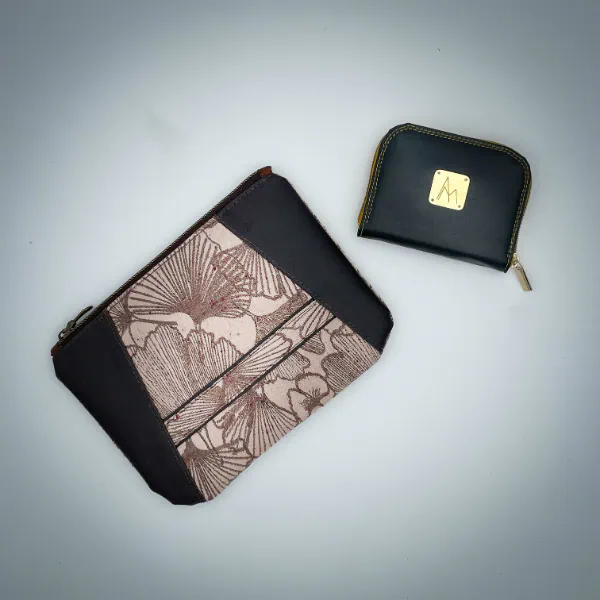
The Pyramide is warm, enveloping, almost earthy. The En Ville is more discreet, more urban, darker. Two objects from the same approach, the same "skin" — but not the same year, not the same character.
They're not made to please everyone. But they speak to someone.
Can you really make leatherwork with grape marc?
What I tested before deciding
I received samples. I left them on my workbench for several days to observe how they behaved flat, in different light, to the touch. Then I cut — with a cutter, with scissors, with a punch. I assembled. I sewed. I watched how seams behaved under repeated folding.
What I observed: the cut is clean, no fraying. The seam holds without the material tearing around the stitches. The fold doesn't mark irreversibly — it leaves a light trace, like fine leather, not a hard crease like faux leather.
What I know so far
What convinced me: the coherence. The "skin" is what it claims to be. It's not trying to imitate animal leather — it's something else, with its own properties, its own imperfections, its own appearance. That's exactly what I look for when working with recycled or bio-based materials: something that owns what it is.
What I don't know yet: how it ages long-term. I've only been using it for a few months. I can't promise you a twenty-year patina. What I can tell you is that right now, it inspires confidence.
Less glamorous on paper. More honest in practice. And in my work, honesty isn't optional — about materials, prices, lead times, and what I can and cannot do.
You deserve to know what you're buying. It's as simple as that.
In Vite Veritas — available at marie-alhomme.com
Two pieces, one-of-a-kind: when they're sold, they're gone. The material itself is available in limited quantities, as it depends on the harvests.
- Pyramide Pouch — light dappled brown, Levate baby carrier wrap, 2023 harvest
- Mini En Ville Wallet — deep ebony brown, 2022 harvest
And if bespoke work with materials that carry a story interests you — whether it's a fabric of your own or a material you'd like to explore together — the bespoke page is here.
In Vite Veritas. It's in the vine — not in the wine — that this collection found its name.
#MadeInFrance #Leatherwork #Craftsmanship #NisiarMaterial #GrapeMarc #InViteVeritas