Kinusaiga: what is it, really? Origins, technique and materials
Kinusaiga isn't an ancient Japanese art: it's a technique invented in 1987 by artist Maeno Setsu. Let me tell you where it actually comes from, how it's done, and what it's made of...
Contents
If you look up “Kinusaiga” online, you'll find the same story everywhere: an ancient Japanese art, born from recycling old kimonos, handed down through generations.
Except... well, it's not true 😏
Kinusaiga was invented in 1987 by Maeno Setsu (前野節), a woman who is very much alive.
And the real story is far more interesting than the one you keep reading.
When I set out to find where it actually came from, I realised the same account was being repeated almost word for word from one site to the next, with contradictions about the creator's name and about the materials used... 😮💨
So I decided to go back to the sources. Except I remember exactly nothing from my one year of Japanese back in 1996 (sorry, Miss), so I used AI for one of the few genuinely legitimate reasons there are: to help me translate and understand what I was finding.
I hope this helps the practice be better understood, and that you'll find all of it as fascinating as I do ☺️
Kinusaiga in one sentence
Kinusaiga means tucking pieces of fabric into grooves cut in a flat board to form an image.
No paint, no sewing, no embroidery.
(Though you absolutely could, to push the thing further. Hang on, that's giving me ideas 🤪)
You glue, you draw, you cut, you trim the fabric, you push it into the slits. Piece by piece, zone by zone. The result is a (more or less) raised textile artwork, entirely handmade.
A 1987 invention, not a centuries-old tradition
Kinusaiga is the work of one single person: Maeno Setsu, born in Nagoya in 1961.
Her path starts out fairly conventionally. She graduated in graphic design from Saga Art College in 1981, worked as a designer in an advertising agency, then went freelance as an illustrator.
It was while looking for an illustration technique that would be truly her own (she was struck at the time by the clay work of illustrator Hayashi Kyōzō) that she had the idea, in 1987, of drawing on kimekomi dolls.
The dolls that started it all
Kimekomi (木目込み) are Japanese dolls that appeared in the middle of the Edo period, around 1736-1741. As the story goes, an official at the Kamo shrine in Kyoto made them from offcuts of wood left over from ritual objects, along with fabric scraps: small figures of 5 to 6 cm, into which he pressed fabric following the grain of the wood.
Which is exactly what “kimekomi” means, literally: to press into the wood grain.
Maeno Setsu's invention comes down to one shift: kimekomi dolls are three-dimensional, and she moved the technique into two dimensions.
A picture, in the end, rather than an object.
That's precisely why Kinusaiga is more than a variation: it's a technique in its own right ✨
And why that name?
For six years, the technique had no name at all.
Then in 1993, Maeno Setsu held her first solo show at the Wacoal Ginza Art Space in Tokyo. 💅🏻
It was her uncle, a member of the Issuikai (a painters' society), who came up with the word. His reasoning is beautifully simple :
You paint in watercolour, you call it a watercolour. You paint in oil, you call it an oil painting. She paints in silk: so it'll be Kinusaiga.
絹彩画: literally “silk colour painting”.
The name describes the technique perfectly: fabric isn't a decorative material here, it's the pigment. Both central and completely dissolved into the whole.
How a Kinusaiga is made
There are several stages, and they've barely changed since the technique was created (mostly what's shifted is the tools) :
- The drawing, part 1: you create a design, by hand and/or on the computer ;
- The board: you cut a piece of rigid foam (very fine-grain polystyrene) to size, then cover it with double-sided adhesive film (her report doesn't mention using any) ;
- The drawing, part 2: you fix it to the board with ordinary tape (she used spray glue) ;
- The slits: you cut along every line of the design with a craft knife or scalpel (she then widens the grooves slightly with a stylus, which I don't do), and the paper pieces left over can serve as patterns for cutting the fabric (that's what I do) ;
- Cutting the fabric: you cut each piece slightly larger than the area it has to fill: that surplus is what disappears into the groove ;
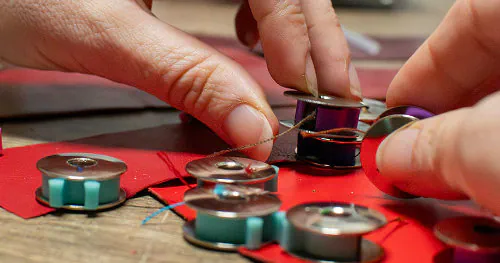
- Tucking: you peel off the backing of the adhesive, position the piece of fabric, and push its edges into the slits with a tool. Usually a seam ripper, though originally it was a spatula, and personally I love a double ball-end modelling tool. Zone after zone, the image appears.
These are exactly the steps you follow with my Kinusaiga DIY kit, minus the drawing: the pattern comes ready, with its matching fabrics.
One detail says a great deal about her standards: Maeno Setsu sources her anti-fray glue (for the edges of her silks) from a mother-of-pearl lacquer craftsman, to be certain it won't stain over the years 🤌🏻
My own personal kink is covering the edges properly and running a ribbon or braid around them, for a genuinely clean finish without depending on a frame 🤷🏻♀️
The fabric: silk, treated like paint
She works almost exclusively with natural silk, taken from antique kimonos found at flea markets and second-hand fabric dealers.
And this is where the internet legend goes off the rails.
Everyone claims Kinusaiga was born from an act of rescue: kimonos too precious to throw away, saved by Art. The documented reality is far more prosaic, and far more telling.
Maeno Setsu buys these fabrics like any other raw material. She's even been known to purchase a whole bolt for a single colour.
She never dyes anything: she hunts for the exact shade, the way you'd pick a tube of paint 🎨
She uses both the face AND the reverse of her fabrics, because the fūai (the hand, the drape, the texture) changes as much as the colour does, and because she describes the reverse as "easy to work with": the pattern there is "often softened".
And she has her rules. For instance: antique silk absorbs light. Impossible to use for a sky or a reflection on water, anywhere you need brilliance: those areas call for newer silk.
She also stores her scraps sorted by colour/pattern, by material, and by intended use... that last criterion hints at an entire filing system 🧠
A quick aside
I find this fascinating, because thinking about it, even in my purely creative work, where my fabrics are most often chosen for their symbolism or their story, how they look is just as unavoidable: texture, colour, sheen...
I too use certain materials like paint, constantly chasing the exact shade or texture, and my materials are stored just like hers (by use (outer/inner), then by material, then by colour).
The difference is that my playground is second-hand (or occasionally dormant stock) rather than new: that's the foundation of my whole upcycling approach.
What Kinusaiga is not
First off, it isn't patchwork.
Patchwork joins pieces of fabric by sewing them. In Kinusaiga nothing is sewn: the pieces hold because they're wedged into the grooves... in my case, double-sided adhesive also holds them down on the surface.
It isn't embroidery either.
No thread is involved in the assembly at all... although, now that I think about it, it could be interesting to bring some in as an earlier step 🤔
And finally, it isn't oshie.
Oshie is a far older Japanese technique, which involves covering padded shapes with fabric. The two get confused constantly.
There is one major difference though: oshie is filed under craft, whereas Kinusaiga claims the status of painting, and therefore of Fine Art. Maeno Setsu wanted to be taken seriously, and for her that ran through this distinction.
She has consistently turned down publishers who wanted to include it in craft manuals, and she writes herself that this refusal is the main reason Kinusaiga never caught on as an amateur practice... which probably explains why almost nobody had heard of it until the last two or three years.
Worth noting all the same: in recent years she has made herself visible on social media, Instagram in particular, where she shares her craft and her work with a wider audience.
Want to give it a try?
Me, I want this gesture to be shared 🤲🏻
- At home, with the DIY discovery kit: the board, a pattern, its matching fabrics and the tools. All you need is a pair of scissors; allow about 3 hours, no experience needed ;
- With others, at a Kinusaiga workshop in the Loire: 2.5 hours around a table, everything provided, and you can bring your own fabric.
What I learned the hard way 😅
Not everything is possible in Kinusaiga, and it's precisely those constraints that give it its unmistakable style :
- fabrics that are too thick won't go into the grooves, and/or won't allow finely detailed areas ;
- very sharp points in a design increase the risk of holes ;
- soft gradients are "impossible": each zone gets one fabric, and one only...
To my mind, the real work, before you even touch a piece of fabric, is simplifying. Distilling, concentrating, in a way 🎯
You have to find the shape that stays readable once it's reduced to flat blocks of colour... which in turn produces those crisp, graphic, raised images that are so characteristic.
That's why the patterns in my kits and workshops are drawn to forgive small slips: wide areas, few sharp points, no tight curves. Your first piece stands every chance 😉
So where do I fit in?
I discovered Kinusaiga a year ago, and I was hooked instantly.
But between the back-to-school rush and the end-of-year craft fairs, I couldn't really get into it until early 2026, so it's been 6-8 months of serious work on it.
What I'm trying to do is take it somewhere else (not "further" ☝🏻), off its home turf.
Maeno Setsu paints landscapes and old Japanese streets, with kimono silk chosen for its colour.
And here's the funny thing: Japan has other traditions where it's precisely what the fabric has lived through that gives it its value.
Take boro: garments patched, mended and re-patched over generations. It started out as poverty, not art: people mended because they couldn't afford to replace. Today those pieces are exhibited and collected 🤯
Or kintsugi, which repairs broken ceramics with gold lacquer: instead of hiding the break, you put it in the spotlight.
In both cases, nobody is trying to erase the damage or the wear, because they are what tells the story.
Kinusaiga, originally, doesn't belong to that family: Maeno Setsu chooses her silks for their shade, not for their past. My version does.
I start from the fabric and its story...
The wrap you carried your child in. Your father's leather jacket. Your grandmother's scarf. Your wedding suit or dress...
Fabrics you're attached to... that you can't do anything with, that you're certainly not going to throw away, and that have been sleeping in a cupboard for years 🥲
(If you're wondering how it works in practice, the process is laid out here.)
Those fabrics raise genuine technical questions, by the way: a baby wrap is far thicker than a silk scarf, and there's no guarantee they'll sit together properly in a groove. That's exactly the kind of testing I do in the workshop (successfully so far 🤞🏻).
... and I play with modern shapes and themes (with something to say).
I'm not particularly keen on the naïve style or on realistic depictions of everyday life... I lean much more towards the abstract and the stylised.
For a start, I've chosen not to limit myself to the usual "plain" squares and rectangles, and I want the framing to play a leading role, because it tells a story too, while shaping the form and style of the piece 🖼️
Beyond that, I've decided to move towards a more conceptual, geometric, contemporary kind of design, in substance as much as in form.
When I'm not working to commission, I choose (here too) not to make things that are "just" beautiful, but to illustrate the values I care about: to shake you up a little, to start conversations... 🌪️
It's the same engine that drives my ready-to-adopt pieces.
I'm gathering all of this on a dedicated site, Kinusaiga Sentimental: bespoke pieces from your own fabrics, the DIY kit and the next workshop dates 👀
The result isn't "one more object": it's a picture, on your wall or on a shelf, that you see every single day... and that speaks about you and your story.
Sources
This article draws on first-hand Japanese sources, and in particular on the cultural heritage assessment report devoted to Kinusaiga, written by its creator as part of her research at Kyoto University of the Arts :
- Maeno Setsu, 《絹彩画》の文化資産評価報告書 (assessment report on Kinusaiga as cultural heritage), Kyoto University of the Arts: read the report ;
- Maeno Setsu, 絹彩画 — 新木目込み技法による布絵, Nichibō Shuppansha, 1999 ;
- Saga University of Arts: announcement of the exhibition marking 30 years of Kinusaiga (2018).